
Trailer Rental Requirements in California: What Every Yuba City Renter Should Know Before Towing

Renting a trailer in Yuba City sounds simple — pick one up, hitch it to your truck, and head out. But California has some of the strictest towing laws in the country, and a lot of first-time renters don't realize that the trailer they're about to tow may legally require a different driver's license, a specific hitch setup, working brake systems, and proper insurance coverage. Get any of it wrong, and you're looking at fines, points on your license, denied insurance claims, or worse — a serious accident on Highway 99 or Interstate 5.
This guide covers the actual rules so you can rent confidently from a local provider like Signature Trailer Rentals and avoid the most common mistakes Yuba City renters make.
Understand GVWR Before You Rent Anything
GVWR stands for Gross Vehicle Weight Rating — the maximum loaded weight of a trailer (the trailer itself plus everything on it). GVWR is stamped on every trailer's identification plate, and it's the single most important number when figuring out what license you need, what insurance covers, and whether your tow vehicle can legally pull it.
A few examples from a typical Yuba City rental fleet:
A 5x8 utility trailer might have a 1,200 lb GVWR
A 7x14 utility trailer typically runs around 7,000 lb GVWR
A 6x12 enclosed trailer is usually around 3,000 lb GVWR
A 7x16 car hauler with a winch is commonly 12,000 lb GVWR
Dump trailers are often 12,000, 14,000, or 16,000 lb GVWR depending on wall height
Deck-over trailers can hit 14,000 lb GVWR
The GVWR — not the actual loaded weight — is what determines which license class you need.
Your Tow Vehicle Has to Be Up to the Job
A valid license isn't enough. Your truck or SUV also has to be physically and legally capable of towing the trailer.
Match Your Tow Rating to the Trailer's GVWR
Every vehicle has a manufacturer-rated towing capacity, found in the owner's manual or on the driver's door jamb. Your tow rating must meet or exceed the trailer's GVWR — not just the empty trailer weight. A half-ton pickup with a 7,500 lb tow rating cannot legally or safely pull a 12,000 lb GVWR car hauler, even if you "only" plan to load a 4,000 lb car onto it.
Also check your Gross Combined Weight Rating (GCWR) — the maximum allowed weight of your truck and trailer combined, fully loaded. Exceeding it strains your transmission, brakes, and frame, and voids most insurance coverage if something goes wrong.
Hitch Class Matters
Hitches are rated by class (I through V), and each class has a maximum tongue weight and gross trailer weight. A Class III hitch rated for 8,000 lbs cannot legally tow a 12,000 lb trailer, period. If you're renting heavier equipment, you'll likely need a Class IV or V receiver hitch and a properly rated ball mount and hitch ball.
A weight-distribution hitch is required or strongly recommended once trailer weight exceeds about 50% of your tow vehicle's weight. Companies like Weigh Safe® make adjustable, level-indicating hitches that take a lot of the guesswork out — and a good rental shop will help you match the right setup before you leave the lot.
California Trailer Equipment Laws You Can't Skip
California requires specific safety equipment on every trailer used on public roads. Most rental trailers will already have this gear, but you're still responsible for confirming it's functional before you tow.
Brakes: Any trailer with a GVWR over 1,500 pounds must have working brakes on all wheels in California. Larger trailers — dump trailers, deck-overs, car haulers — use electric brakes that require a brake controller installed in your tow vehicle. If your truck doesn't have a brake controller, you'll need to install one (or have one installed) before renting anything over 1,500 lbs GVWR.
Breakaway switch: Trailers over 1,500 lbs must have a breakaway switch wired to a trailer-mounted battery, with a cable connecting it to a fixed point on the tow vehicle. If the trailer disconnects, the switch automatically engages the trailer brakes.
Safety chains: Required on every trailer. Both chains must be crossed under the tongue and rated to hold the trailer's full GVWR.
Lighting and reflectors: Tail lights, brake lights, turn signals, license plate light, and side reflectors are all required. Trailers wider than 80 inches also need clearance lights and side marker lights front and rear.
License plate: All trailers must be registered with the California DMV and display a valid plate. Most rental trailers are registered under the Permanent Trailer Identification (PTI) program.
Extended mirrors: If your trailer is wider than your tow vehicle (which is true for almost any cargo, dump, or car trailer), you're required to have extended tow mirrors so you can see past the trailer.
Loading and Towing Safety
Even with the right license, hitch, and equipment, how you load the trailer matters enormously.
Tongue weight should be 10–15% of total trailer weight. Too little weight on the tongue causes trailer sway. Too much overloads the rear axle of your truck. A weight-distribution hitch helps keep this balanced on heavier loads.
Distribute heavy items low and over the axles, not at the back of the trailer. Tail-heavy loads are the leading cause of dangerous trailer sway on highways.
Strap everything down with rated tie-downs. California law requires loads to be fully secured — no exceptions. CHP routinely cites drivers for unsecured loads, and an unsecured item that falls off your trailer makes you liable for any damage or injury it causes.
Drive slower and brake earlier. Trailers add stopping distance and reduce your ability to maneuver. California's speed limit when towing any trailer is 55 mph, even on freeways where the posted limit is 65 or 70. This is enforced.
What to Ask Before You Sign a Rental Agreement
A good rental shop will walk you through everything above before you take possession. Before signing any agreement, confirm:
The trailer's exact GVWR (and that your license covers it)
Whether your tow vehicle is rated for the trailer's GVWR
That you have a brake controller if required
That all lights, brakes, and the breakaway switch work
What the rental's insurance/damage policy is
How returns work if you bring it back damaged or late
Whether the company will help you hook up correctly the first time
If a rental company hands you keys without checking any of this, that's a red flag. The good ones inspect your tow vehicle, walk through the hitch setup, and confirm you understand the trailer before you leave.
Renting in Yuba City and the Surrounding Area
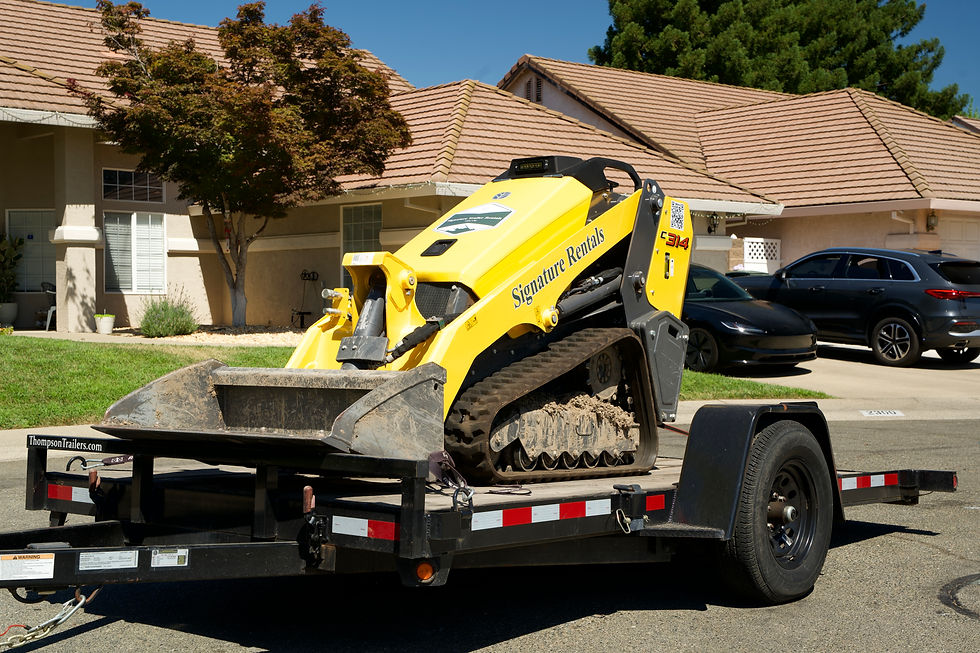
Signature Trailer Rentals serves Yuba City, Marysville, Linda, Olivehurst, Gridley, Sutter, and Plumas Lake with a fleet that includes utility trailers, dump trailers, enclosed trailers, car haulers with winches, deck-over trailers, wood splitters, and mini skid steers. Pricing is straightforward — daily, weekly, and monthly rates posted upfront — and the team can help match the right trailer and hitch setup to your tow vehicle and project.
Whether you're cleaning out a yard, moving across town, hauling a project car, or working a construction site, the right trailer rental is the one you can legally and safely tow. Take 10 minutes to verify your license class, your truck's tow rating, and your insurance coverage before you book. It's the cheapest insurance against a very expensive mistake.
Ready to rent? Call Signature Trailer Rentals at (530) 649-5285 or explore the trailer fleet to book the right equipment for your project.
This article is for general informational purposes and does not constitute legal advice. California towing laws change periodically — always verify current requirements with the California DMV and California Highway Patrol before towing.



Comments